16 November 2010


The Music in Ashita
Above this, there are some scenes that music is used effectively.
In the wedding ceremony scenes, woman sings a song about Japanese pronunciation on number. This song means nothing. It doesn't include social, political problem and worry about the war. Thus, I thought this song can be interpreted their ordinary days: they don't have to feel anxious and consider deeply.
A solider plays the harmonica in the room which his collegue is not long for this world. The melody he plays make us feel lonely, sorrowful, and mournful, because it allude the death of one soldier in no distant future.
Review 2 (Yuki)
Point of View
This movie is filmed in Japanese point of view. In this movie, women and children have roles just as important as men. The girl looked at the sky and bomb just explodes without any caution. This is the view from below. It shows Japanese lives right before A-bomb, it certainly is Japanese point of view. There are few scenes of Korean soliders and English soliders. Those Korean soldiers speak in Korean. Perhaps this is not really Japanese point of view, but I doubt if this was Korean point of view. I think this scene's point of view is anonymous, it just depicts the situation of that time.
Form of Social Criticism
I think this movie gives us a little sence of absurdism. Absurdism is the feeling people get when they can't find any meanings to life, people, and themselves. From the line in the beginning, "Should humans be erased like fog just the same as my mother and father?", audience gets the idea that something bad is going to happen to these characters but all they can do is just to keep on watching till the ends. In some sense, audience is waiting for their time to come. After bomb explodes, it makes each individual's life, all the joy and struggles, meaningless. This gave me a feeling of absurdism.
This movie also has nihilism. Just like "The man who stole the sun", all the struggles that characters went through and joy of life become nothing when nuclear explodes. There is nothing left. We don't know who survived and who died but the movie ends with explosion and it really makes it seem as if the world is over (at least their world is over).
The line "should human be erased like a fog the same as my mother and father?" gives us negative feeling, but I thought it may give us a little of hope as well. It says "my mother and father", thus it may be implying that the baby survived. I am not sure whether the director implied this or not, but I think it can be read in that way as well. (In addition, this line comes from a real person who survived from the bomb in Nagasaki, so there is a possibility of survival, and at least there are people who survived, there is a little hope.)
Reflection
After studying about this movie, I think the main message is that it can happen to anyone. I did not think that this movie is trying to make audience sympathize (althought, as a result, audience would). In this film, there is no any particular main character. Everyone in the film is important and they all have different things to deal with in life. It really dipicts our lives in the way that each individual are different and we encounter different events in life. In addition he also showed us Korean solider's life and English solider's life. They were in Nagasaki, thus they also died from Atomic Bomb. People who died from Atomic Bomb is not only Japanese and it could be anyone if s/he were in Nagasaki. No one has a reason to be killed by A-bomb. That's the message that I got from this film.
15 November 2010
My feelings to the project
13 November 2010
About 'Ashita'
Country: Japan
Date of Release: 13 August 1988
Also known as: Tomorrow (International), Der Tag Davor (East Germany)
Director: Kazuo Kuroki [Related Post: (1), (2)]
Screenplay: Masako Inoue, Kazuo Kuroki, Juuichirô Takeuchi
Story: Mitsuharu Inoue
Cast:
Kaori Momoi (1) as Tsuruko / Pregnant sister
Kaho Minami (1) as Yae/ Bride
Nobuku Sendo (1) as Akiko/ Youngest sister
Shiro Sano (1) as Shoji/ Bridegroom
Arthur Kuroda (1) as Tsuguo/ Shoji's friend
Nomination and Awards
Awards of the Japanese Academy:
Nominated: Best Art Direction - Akira Naitou
Best Cinematography - Tatsuo Suzuki
Best Lighting - Kenichi Mizuno
Best Music Score - Teizou Matsumura
Best Supporting Actor - Kunie Tanaka
Blue Ribbon Awards:
Won: Best Actress - Kaori Momoi
Hochi Film Awards:
Won: Best Film
Kinema Junpo Awards:
Won: Best Actress - Kaori Momoi
Best Director - Kazuo Kuroki
Mainichi Film Concours:
Won: Best Art Direction - Akira Naitou
Nikkan Sports Film Awards:
Won: Best Director - Kazuo Kuroki
12 November 2010
In the view of cinema studies...
Review 1 (Yuki)
Throughout this movie, music made the scenes very peaceful. The music was slow and very kind. If there is no line in the beginning of the movie, "should humans be erased like fog just the same as my mother and father?", audience wouldn't think the movie would end in such tragedy.
Most of the factors in this movie are dramatic truth. The vertile truth we can find is time records and image of A-bomb. Some of the images of buildings in Nagasaki is based on facts but since it was destroyed by the bomb, producers must have made imitation of the building. Also, the "red paper" to inform draft was actually used. On the internet, I have read that the line "Should human be erased like a fog just the same as my mother and father" came from actual survivor of the bomb, but there is no detail like who said it and so on.

The time records is vertile truth. I am not sure if this image is real A-bomb dropped in Nagasaki. I could not find out. The image of Urakami Tensyu Do (Urakami Cathedral), located 500m (1640ft.) northeast from center of the explosion. Urakami is the name of the place. It can also be translated as St. Mary's Cathedral, and it was known as the biggest cathedral in East of that time, until it was destroyed by A-Bomb. No one in the cathedral survived. Its wreckage and melted statue of Mary are one of the most famous thing to see in Nagasaki Peace Museum.
Cathedral was rebuilt in 1959, but its appearance is different from original. Since there wasn't and technology of color animation, this image must be the imitation of original cathedral.

This is the real record of Urakami Cathedral after it was destroyed by Atomic Bomb.
Photo by AIHARA Hidetsugu, in his photographic collection "Genbaku wo Mitsumeru" (Looking at Atomic Bomb).
Taken in Jan. 7th, 1946.
See: World War II Database
Around the time this movie was made (1988), Japan was in the middle of Bubble economy. In one of Kuroki's interviews, he said that producers could gather big amount of money for the production. In addition, Toho (the industry) is one of the biggest film industry in Japan. It convinces why he could choose those famous actors (most of the actors in the movie were very famous and popular in Japan.)
Interview with friends
Interview with friends
After watching the movie, first thing she thought is "This movie is very Japanese."
Cast Profile - Arthur Kuroda

 At the age of 21, Arthur made his debut in TV drama, acting in ‘Meiken Goroo no Bouken Viva! Canada”. Starting from 1982, Arthur began to perform in various TV dramas. Many female audiences were attracted by him because of his sweet face and Western aura. In 1986, Arthur released his first single, Angel Baby.
 - Hachiko Monogatari (Shyoutiku, 1987)
- Rakuyou ( Rou Tomono, 1992)
- Koara Kachou (Kawasaki Minoru, 2005)
11 November 2010
Additional Information of the Director and the Film
When he was 5 or 6 (before primary school), he moved to Manchuria with his family and spent his childhood there. He came back to Japan to go to junior high school in Miyazaki Prefecture, where his grandparents lived.
After he got back in Japan he started to work in the factory. The factory was bombed during he was working. He survived from aerial bombing but 10 of his friends died. He saw his friend's head cracked open and his friend losing legs, all happening in front of him. This became his trauma. Together with stress caused by his difficulties with Miyazaki's dialect, he had neurosis. The World War II ended when he was 14 by neuclear bombing. (It may be interpreted differently. At least in Japan, the end of war is the neuclear bombing.)
In one of his interview, he said his experience of living in colony and experience of surviving from bomb had always been in his mind. Time after time he remembered his friends died in aerial bombing.
In Japan, the film "Tomorrow - Ashita" is known as Kuroki's Trilogy of Requiem, together with "Utsukushii Natsu Kirisima" (2002) and "Chichi to Kuraseba" (2004). (English titles are "A Boy's summer in 1945" and "The Face of Jizo".)
These three movies are about people's life before/ after neuclear bombing. The experience in his childhood may have caused him to consider tragedy of war happening not in the battlefield but in people's daily life. In the film "Tomorrow - Ashita", he drew attention to people's daily life and suddenly tragedy took over. In other two films of Kuroki's Trilogy of Requiem, the main characters suffer from feeling of guilt after surviving from A-Bomb (Guilty feeling that s/he survived while others died).
Thus, his experience in childhood certainly had influenced his film making.
Interview: Japanese Documentary Author Interview No.16, Kazuo Kuroki. Yamagata International Film Festival. For English translation, click here .
Cast Profile - Shirou Sano
 Shirou Sano as Nagakawa Shoji in 'Ashita'. He is the husband of Yae.
 The following are some of Shirou’s major works in movies and TV Drama:
- Mainichi ga Natsuyasumi (1994)
- Godzilla 2000 Millennium (1999)
- Zutto Anata ga Sukidatta (1992)
- Dare nimo Ienai (1993)
Interview with friends
Review


All the happiness was obscured by the war, and the director also included some foreigners, the American David and the two Koreans, to show that the war not only destroying Japan, but their allies and enemies as well. The director was tried to make the Japanese realized that they should not only have pity on themselves because the bombs were dropped on their land, they should also be sorry because their countries chose to participate in the WWII. This idea of reminding the Japanese that they were both victim and assailant in WWII is also included in 'Gojira' (1954), while it came out because of the continuous testing of nuclear bomb, it also released radioactive fire to destroyed Tokyo.


Through this film, the director also wanted the audience to treasure every chance we have today. Just like Shoji’s stepfather said, “no one knows what’s going to happen tomorrow. I should do what I can do today.” The stepfather knew how to treasure because he once faced the death of his loved one, Shoji’s mother. He understood that human’s life is so fragile that it can be gone in a sudden. However, as Shoji was so young when his mother passed away, he did not learn the lesson. If he knew there would be no tomorrow, he would not hesitate to tell Yae about his mother.
Although the film ends in such a nihilism way, there is a scene which gives a little comfort to the audience. It is the movie that Haruko watched. The man said that even he only lived with his father for a week, he was still very happy because it was always his dream. This refers to Yae and Shoji, even they only married for one day, and Tsuruko’, whose baby only one-day-old, they would still feel happy because their dreams fulfilled.
10 November 2010
Cast Profile - Nobuko Sendo


Nobuko had performed in a number of movies and TV dramas. One of the most representative movies is ‘Kiryuin Hanako no Shogai’ (1982). For TV Drama, it is the ‘Christmas Eve’ (1990). Nobuko also won the New Actor Award in 1984 in the Japan Academy Prize, for her performances in ‘Sasame Yuki’ and ‘Hakujasho’.
Analysis of the movie
-> The director wanted to show us happy scenes before dropping A-bomb to maximize sadness.
Characters also hope there is another tomorrow for them. But actually it isn't.
There are three happy scenes in the movie: childbirth, love and get married.
Childbirth


Love


Marriage


and.......


2. Symbolic scenes
Here, a fly is flying around the light and the fly soon died. It means nihilism indirectly by showing the fly.
Even though people try hard to live daily life, they all disapper in the air.
The moon is quite bright and it looks like to explode soon. We thought two interpretation. One is the director wanted to foreshadow that there will be an A-bomb soon. The other explanation is the director gave life to the moon and it expressed the sadness of tomorrow A-bomb dropping.
American soldier needs food, but the owner of the shop refused to give food to the American soldier
Main characters in the movie


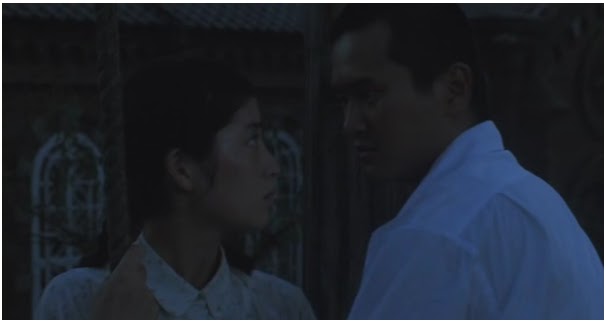 <Aki& Hideo>
Cast Profile - Kaho Minami

Kaho Minami is the bride Yae in 'Ashita'.
 |
| Kaho and Ken Watanbe |
- 19th Takasaki Film Festival – Best Supporting Actress
- Blue Ribbon Awards 1990 – Best Supporting Actress
Koreans in the Japanese military
00:03~00:08 If you do something behind our back, people will say bad things about you.
00:08~00:11 Please grant our wishes.
00:11~00:12 Are you sure about what you are saying?
00:12~00:14 Everyone wants to eat.
00:14~00:18 First of all, do you guys have money?
00:18~00:24 We came to Japan for the Emperor. We really don't have enough food.
00:24~00:27 Don't be confused.
00:27~00:30 Do you think you can get some food if you say like that?
00:38~00:41 It's rotten.
00:41~00:43 We can still eat it.
00:43~00:46 How can they treat us like that.
00:46~00:50 Why do they look down on us Koreans.
00:50~00:52 I know how you feel.
00:52~00:58 But what we have to do now is to survive.
Source:
Korea under Japanese rule - Wikipedia
Images-Final Scenes


 hanging out the wash, giving a child the breast, flowers, newly married couple,

 Peaceful sceneries is going on without any strange things
 Girls parade is appeard, and we can find one girl whom we already know.
 She looks up to see the sky and feels a little strange.
 This is sufficient to let us know what happens to family.
Images-Soldier's Day (Life and death)
 soldier comes to wedding ceremony of his friend.

 When returning his unit, he finds condition of his colleague has worsend.
 After for a while, he gets the phone call which infroms about the death of his colleague.
 He and his colleagues holds a funeral for him.
 He feels a kind of vain, so he goes to one prostitute.
  In the room of prostitute, an insect rushes into the light and finally dies.